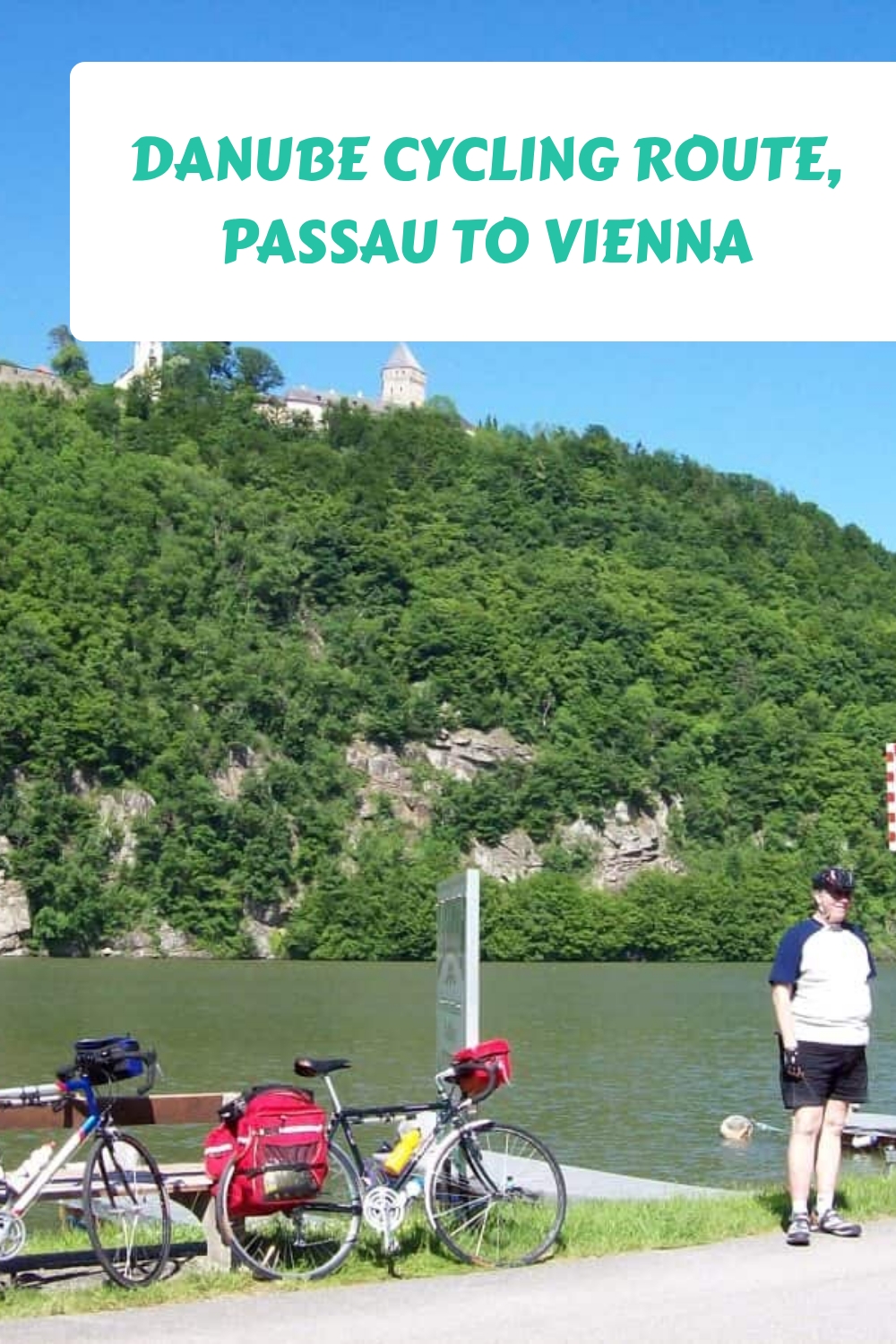


Looking to cycle the Danube River Route in Austria?
Well, you have come to the right place, as 3 friends and I cycled this route from Passau to Vienna, and later continued to Budapest.
The most popular section of the Danube Cycling Route is an easy one-week journey, which is a relatively flat, 326 km (203 miles) scenic journey from Passau, Germany, to Vienna. You travel along a bike trail or quiet roads with little traffic, which makes it one of the most popular bicycle touring routes in Europe. The Danube is Europe’s second-longest river.
Use my helpful guide to plan your ride along this amazing route.
Distance: relaxed trip of 326 km (203 miles), taking 6 to 7 days to ride 45 to 60 km daily
Difficulty: on quiet roads and bicycle paths. Flat with minor hills in the Wachau Valley area on paved surfaces
Suitable for: family holidays, long-distance bicycle touring
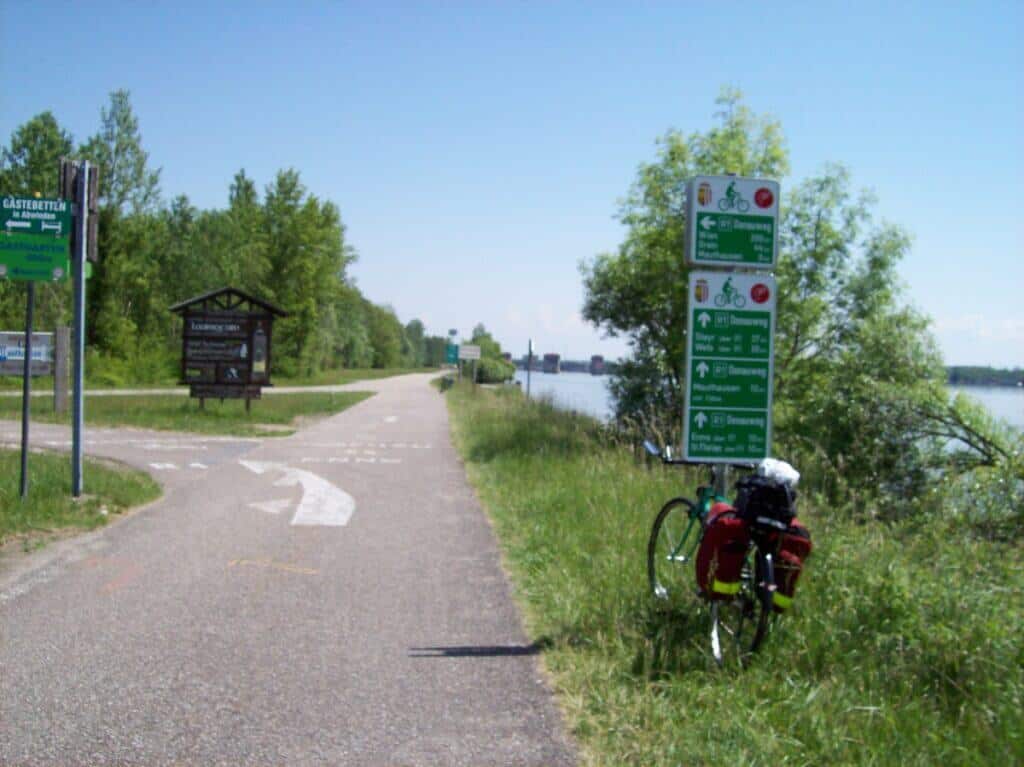
It is almost impossible to get lost with route signs or maps posted at frequent intervals at all the turns. Best of all, this Austrian cycling route is paved for the entire distance, frequently on both sides of the romantic blue Danube River.
On this European cycling route, you will not be alone as Austrians, Germans, and international cyclists travel along a route that has emerged as one of Europe’s most popular cycling routes.
Bring your own bikes, which is what we did, and carry our gear in the waterproof Ortlieb rear panniers. You may also choose to use one of the rentals available from the train station in Passau. Head west to east and take a copy of The Danube Cycleway: Donaueschingen to Budapest
Highlights of the Danube Cycling Route
Passau – St. Stephan’s Cathedral with the largest organ in the world
Danube Bend – the river has to change its direction by 180 degrees, and you need to take a bike ferry
Linz – Upper Austrian capital and the historic old town of Linz
Enns – the oldest medieval town in Austria, with the longest wooden bridge in Europe
Grein – baroque village
Melk – Abbey on a hill overlooking the river
Wachau – a World Cultural Heritage area famous for its wines
Dürnstein – a picturesque cobblestone village with castle ruins
Krems – a walled town
Vienna – is famous for its Imperial palaces, coffee houses, museums, and music
Starting in Passau, Germany

Passau
My Danube River cycling adventure began in Passau, Germany, a city of the three rivers with superb views of the old town. This quaint old quarter is dominated by St. Stephen’s Cathedral, known for having the largest pipe organ in the world. If you wish to listen to the sounds of the largest church organ with its 17,974 pipes, there are concerts at noon each workday for an additional cost of about 5 euros. Check the schedule for additional performances.
Several cycle paths meet here, including the Tauern Bicycle Route from the south and Salzburg.

We stayed in the Rotel, an interesting accommodation for cyclists with a bicycle lockup and dining right along the river and cycle path. Whether you stay in a single room, as I did, or a double, these rooms are small with little space for any gear.
There is plenty of other accommodation, such as the Hotel Passauer Wolf Garni, which is also along the bike path.
Before you start your cycling trip, you may wish to explore Passau on a guided walking tour. Another option is a Passau sightseeing cruise, which passes famous sites like Oberhaus Castle and the Monastery Maria Hilf.
Cycling Passau to the Schlogen Bend and beyond
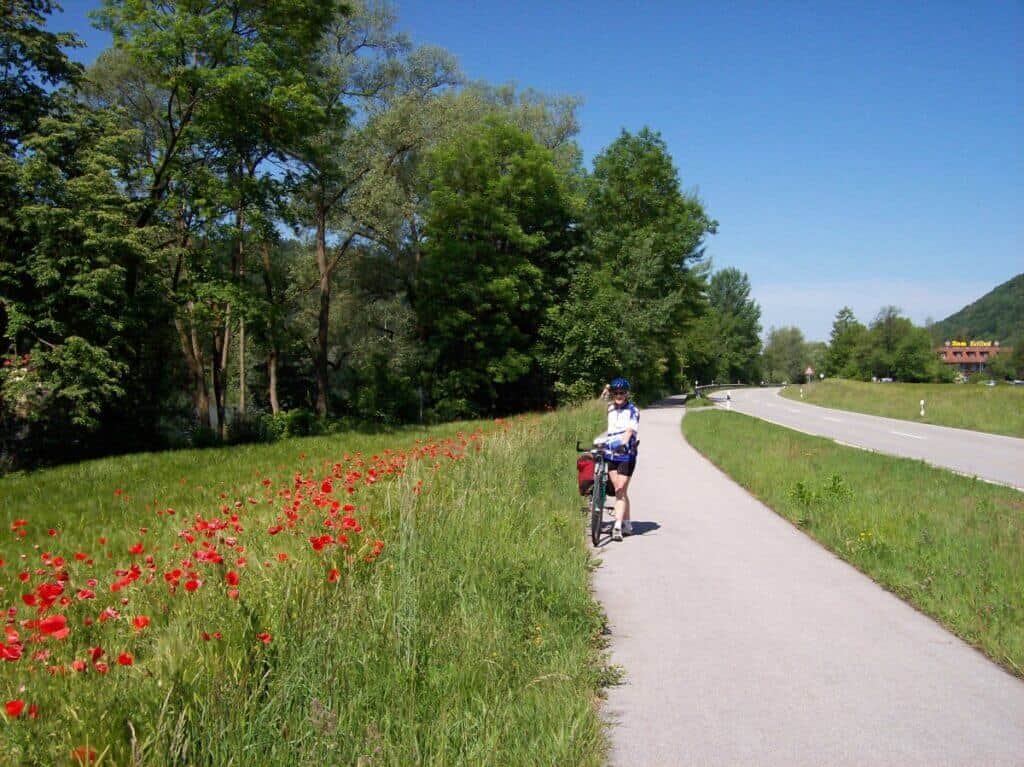
The first section is in an area known as the Upper Danube Valley, and I rode along the north shore of the river on my bike along a paved trail through forests, rural areas, and a few picturesque villages. After about 27 km, you cross the border from Germany to Austria, although there was no sign that I could see.
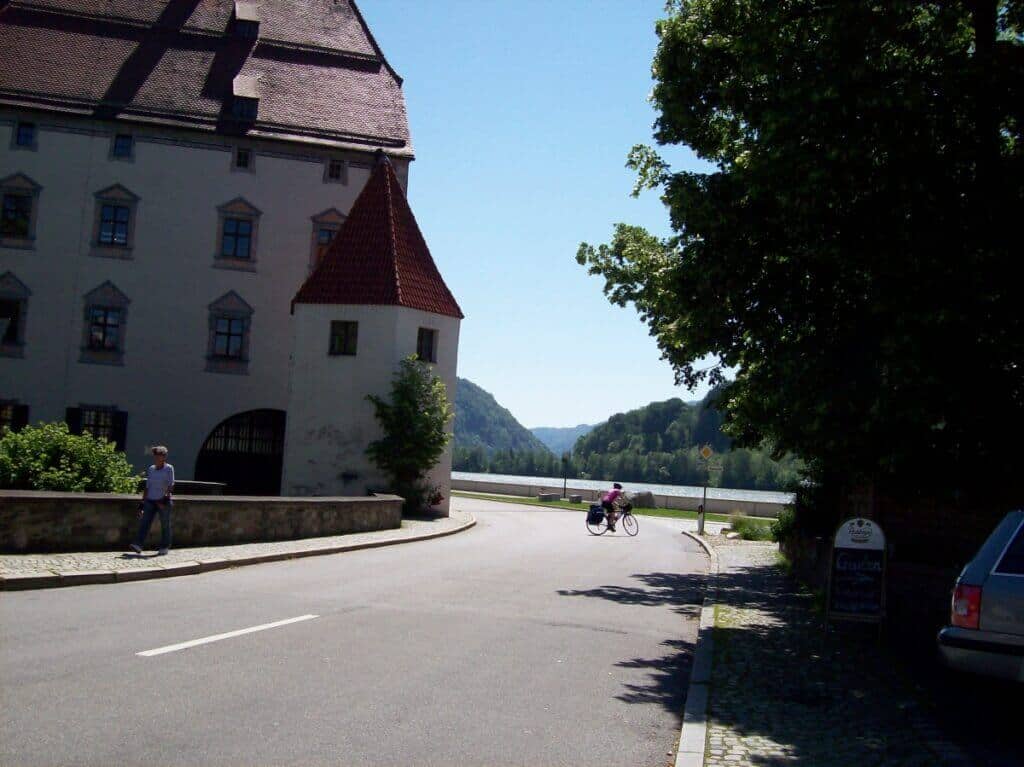
After entering Austria, I was riding on quiet roads and streets through interesting villages such as Obernzell, which were usually hugging the river, although sometimes we headed slightly inland. I did stop at a riverside cafe for lunch, where we enjoyed strawberries with cream. At other times during the trip, I, of course, had Wiener Schnitzel and apple strudel.
If on the south shore, be sure to stop at the ornate Engelzell Abbey, which is Austria’s only Trappist Monastery and is situated on the banks of the Danube about halfway to the Schlogener Schlinge from Passau. You will want to try the homemade beer and visit the little shop with local products.
Schlogen Bend
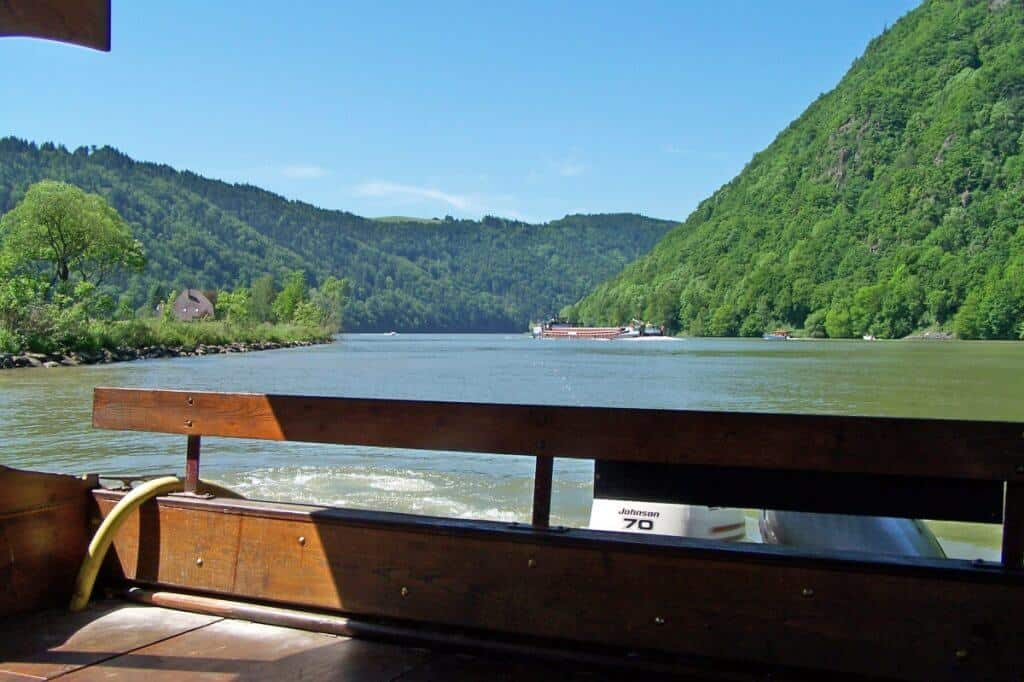
The famous Schlogen or Danube Bend is a natural phenomenon where the river makes a sharp turn of 180 degrees and, for several hundred meters, flows back towards its source due to a giant granite boulder.
You will need to take one of the three bicycle ferries spread out over a short distance to get to the south shore, which is available for a few euros. I suggest following the path further past the first ferry to the second option, which is a better choice. I had to wait a few minutes as the ferry was on the opposite shore, but we had plenty of time.
Aschach
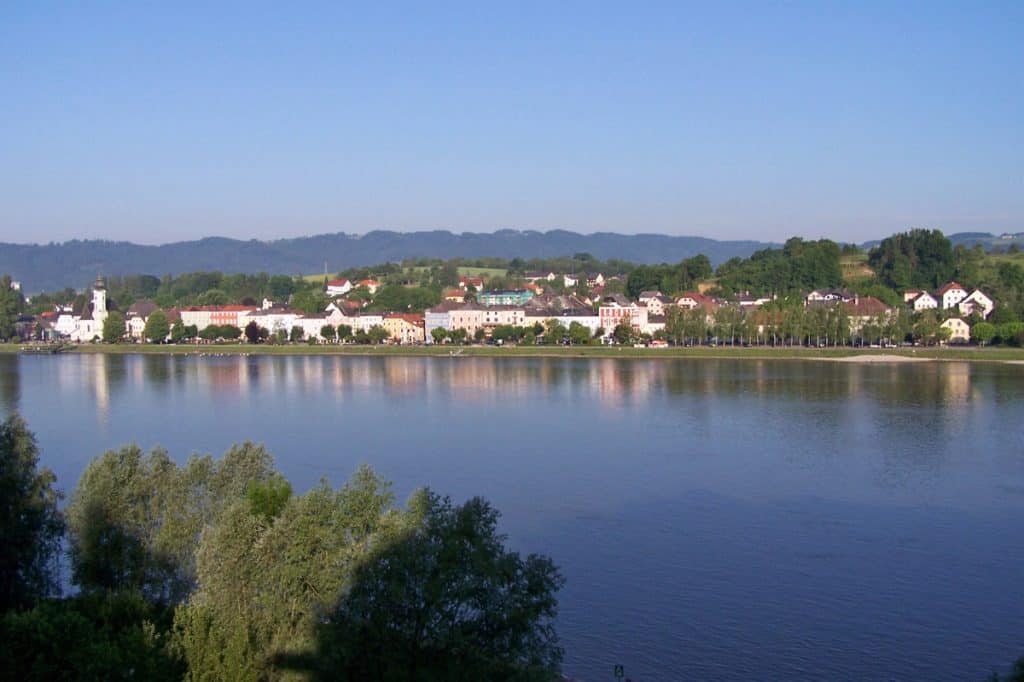
Once again on the south shore after the Schlogener loop, I continued our leisurely cycle ride along some minor roads through wooded forests.
While some cyclists and many tour overnight at the Schlogen, I recommend a better place to stop for the first night is the market town of Aschach, a pretty town with many cafes along the waterfront, although a little further along the route. I stayed in the Hotel Faustschlossl across the river from the town. The official Austria Tourist Office website has more information to assist with your visit.
Linz
On the second day, continue along the Danube Bike Route through the slowly widening green fertile Eferdinger Basin and head back to the north shore and through charming villages such as Ottensheim, where we were routed all over town until returning to a section of the Danube.
By going along the Danube riverbank on the north shore, you miss the traffic in the large industrial Upper Austrian capital of Linz. You will pass through the large Donaulande park, where I stopped for lunch, as it has picnic tables, washrooms, and restaurants.
Enns
Back on the south shore, I entered the state of Lower Austria and continued to Enns, the oldest town in Austria, dating from Roman times, and a slight detour off the official Danube Bike Route by about 7 km, but well worth the effort. We stayed in the Hotel Zum Goldenen Schiff, located right in the picturesque old part of town, in the main square. Enns is worth an extra night, which we did.
Plenty of nice restaurants in the main square, along with a historic tower. You will want to explore the medieval town of Enns, which was along a trading route, and perhaps Ennsegg Castle or the Municipal Museum Lauriacum.
You can also take a bike ferry across the Danube and, following a steep climb, visit the Mauthausen Concentration Camp (an audio tape in English is available).
Grein

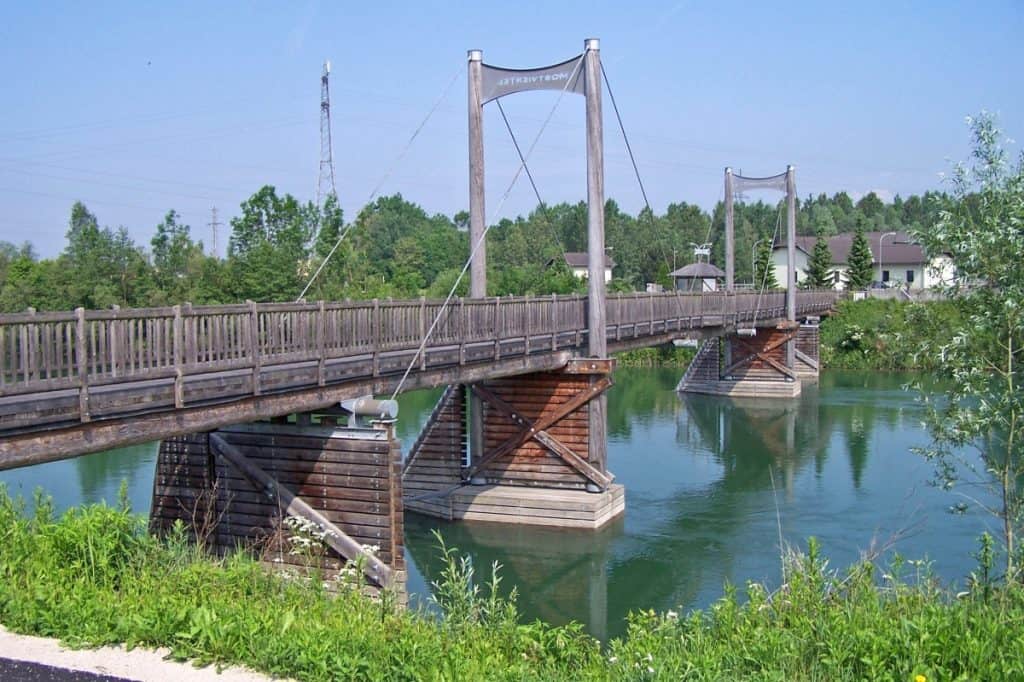
Day three along the Danube Cycling route starts by taking you across the longest wooden bridge in Europe at the edge of Enns, then through the Austrian countryside.
When I reached the dam, I crossed to the north side and visited the Celtic village of Mitterkirchen about 2 km north of the Danube. Continue along the north shore to the baroque town of Grein. We made a mistake and were on the wrong side of the river, so we missed Grein, a highlight with many visitors.
A side trip some take is to the Maria Taferi pilgrimage Basilica, a national shrine dedicated to the sorrowful Mother of God. Located on a hill 233 meters above the Danube, it provides a wonderful view of the Donautal Valley. The best feature is the treasury, a painted room in a colorful Baroque style with frescoes on the ceiling showing the creation story.
Persenbeug

My destination today is the beautiful little Persenbeug with the bicycle route going right by the front door of the Gasthof Bohm, with a wonderful patio to enjoy a beer and talk with the numerous other cyclists. I mean, it seemed every guest was a bike rider, and the bicycle storage room was crowded.
Cycling the Scenic Wachau Wine Region
Melk
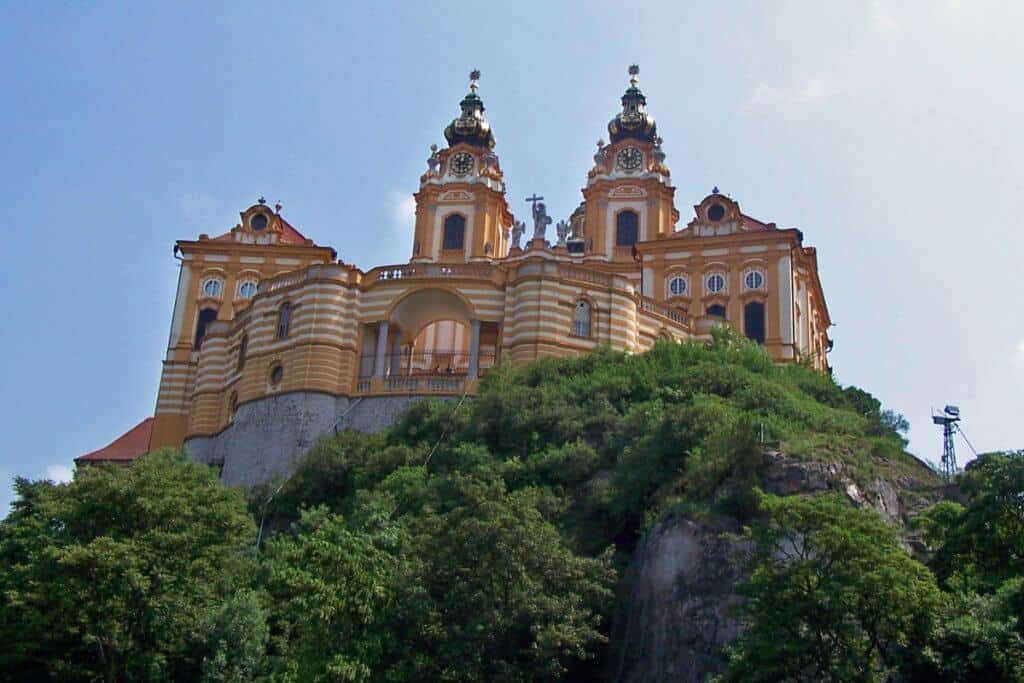
On the fourth day, I continued our European Cycling trip by heading to Melk, home of the famous Benedictine pilgrimage church built between 1702 and 1735, which is well worth a visit. The park below the abbey by the river provided us with our lunch spot.
After our picnic lunch, I continued cycling, but besides visiting the abbey, you can also take a river cruise.
Important: just past Melk, take the bike lane crossing to the north shore of the Danube River for the best views of the entire trip as you ride through the scenic Wachau Region. Good photo opportunity when crossing the bridge.
Wachau Valley
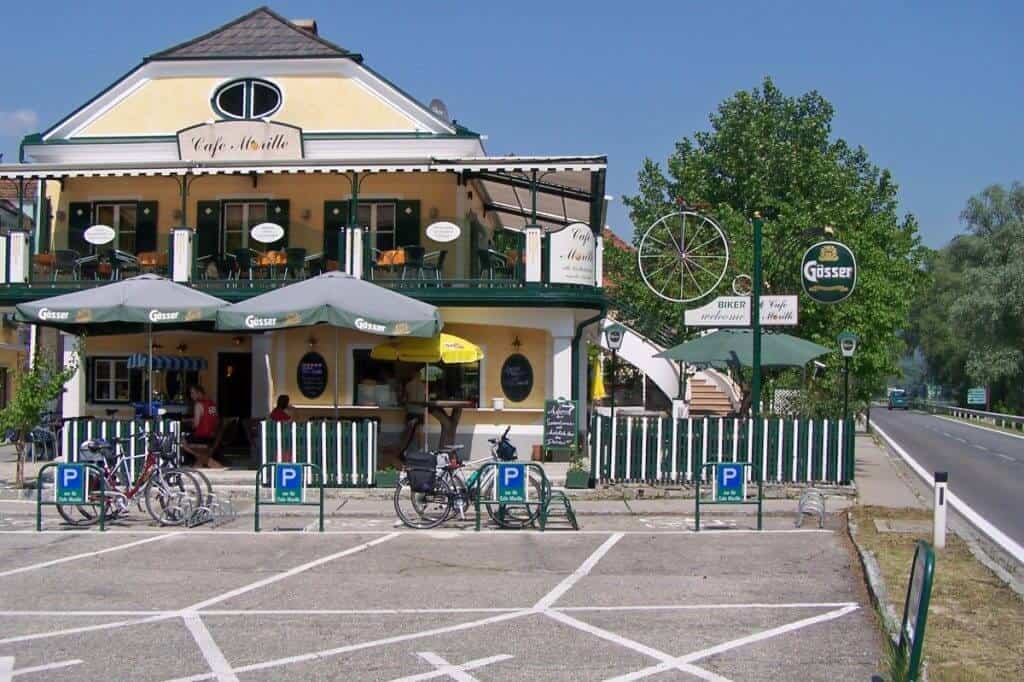
The Wachau Valley (a UNESCO World Cultural Heritage region) with its little wine towns of Spitz and others is the center of the Austrian wine region, with many cafes, wineries, and vineyards crowding the route. There are some distinctive ones produced here, and you may want a wine tasting of some while you are riding in the area.
You will find the picturesque Wachau region a little harder to ride in, as it has a few short, small hills to climb, nothing too serious. The route here is slightly away from the river, although there are magnificent views, and you can still see it.
Durnstein

Then it is on to Dürnstein, where Richard the Lionheart was imprisoned in medieval times. The town offers charming shops, but take care on the cobblestone streets. You can see the Dürnstein Castle ruin on the hill to your left. There is also a picturesque church by the river featured in many photographs.
Krems
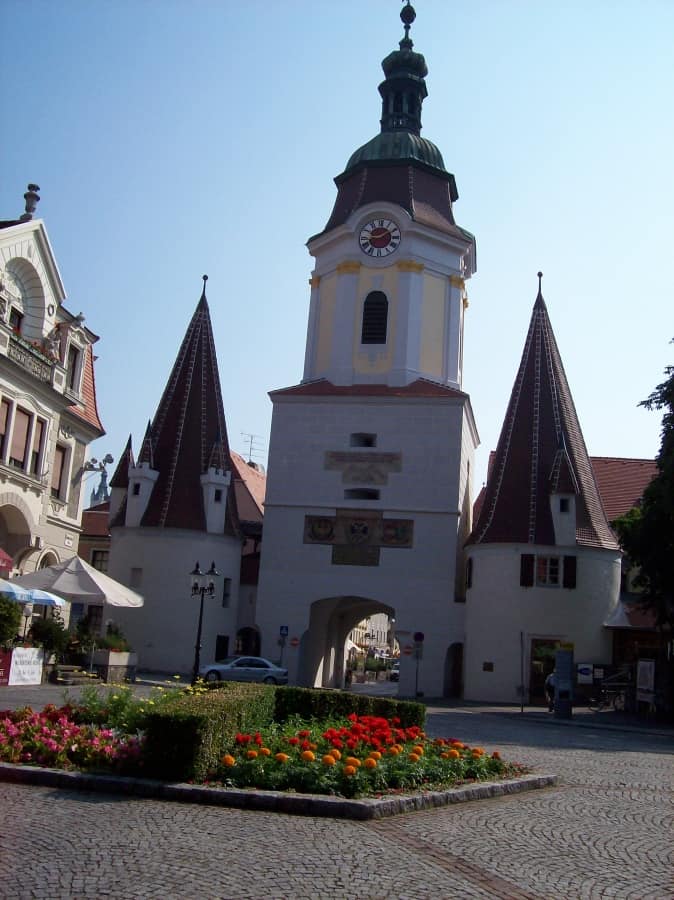
I continued our bike ride to the university town of Krems, a highlight of this tour, where I spent the night in quaint accommodations in the Hotel Alte Post, built in 1584 with a nice courtyard. Many cafes are located inside the city walls in the Old Town on the pedestrian-only main street. This area is worth a two-night stop.
You may wish to go on the Danube River Cruise through the Wachau Valley, which includes a 3-course meal.
Cycling to the gates of Vienna
Tulln
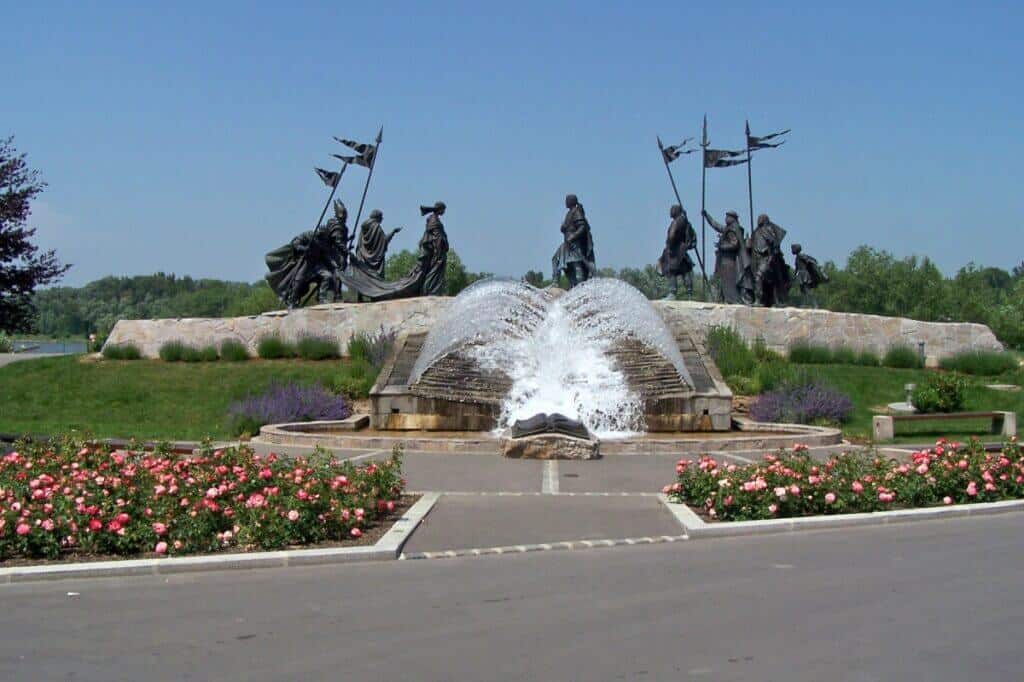
The next day, I continued along the south shore banks of the mighty river, passing a bike cafe and plantations of elderberry trees, while still on the Danube Bike Route to Tulln, where I spent the night. Entering the town and right along the Danube path is an impressive set of fountains and statues that depict some of the history of the area.
Otherwise, not much to see in Tulln except the river flowing by our hotel, as we enjoyed wines from the region on the patio.
Departing Tulln, we continued to follow the course of the Danube, passing beautiful meadows into Klosterneuburg, located on the north edge of the Vienna Woods, which inspired the well-known Johann Strauss waltz. It is also the site of an impressive monastery.
The Klosterneuburg Monastery, founded in 1114 by Margrave Leopold III of Babenberg, is a powerful symbol of his legacy. The Augustinian monastery houses several important works of art, including the Verduner Altar, constructed in 1181.
Vienna

The final kilometers of your bike tour take you into the Danube Metropolis of Vienna itself, with one route heading to the Westbahnhof Train Station and the other heading to the city center.
While in Vienna, be sure to take a city tour by bike along the Ring Road bike lane, passing many of the city’s major sights and stopping at one of the typical coffee houses for your Americano coffee or cappuccino. Vienna is worth a 2- or 3-night stay with many hotels catering to cyclists.
When cycling along the clear water of the Danube on the bike route in central Vienna, we could see the famous Wiener Riesenrad, the giant Ferris wheel in the Prater Amusement Park, dating from 1897, a must-do.
The famous Naschmarkt is a Saturday flea market with about 120 stalls with food, costumes, antiques, and souvenirs, visited by locals and tourists alike. Other sites in this great city include the Schonbrunn Palace, the Belvedere Museum, and St. Stephen’s Cathedral.

I stayed at the Hotel Stadthalle, a bicycle-friendly hotel near the train station where the airport bus had left us. The hotel has a bike storage area where we had left them while on this journey, and we found plenty of other cyclists staying there.
To celebrate your completion of this bike tour along the Danube Bike Path, you should treat yourself to the famous Sachertorte Cake. First created in 1832 by 16-year-old apprentice chef Franz Sacher when the Austrian State Chancellor requested a great dessert for some special guests. You can find it at many of the Vienna cafes, including Cafe Sacher.
Danube Cycling Route Map
How to Get to the Start of the Danube Trail

Your Danube River cycling adventure for this section begins in Passau, which may easily be reached by train from Munich or Vienna. Note that on Fridays and Saturdays, if traveling from Vienna, trains can be crowded with local cyclists, so you need reservations or choose to start your journey on a different day than the weekend.
While there are direct trains, we had to make 2 connections with our bicycles on a Saturday afternoon after departing Vienna Central Station. The train ride was just loaded with cyclists. When purchasing, also remember your bike requires a ticket.
FAQs: Danube Cycle Path from Passau to Vienna
When to cycle the Danube Bike Path?
The best time to tackle the Danube Cycling Route is either May/June or September/October, when the weather is still good but you don’t have the crowds you get during the summer.
Which direction to cycle the Danube route?
Most cyclists start in Passau and head downstream to Vienna, Budapest, or even further.
Where does the Danube Cycle Path start?
The Danube River flows from its source in Donaueschingen in Germany’s Black Forest all the way to the Black Sea on the Romanian coast and is part of the EuroVelo6 route. Most cyclists just go from Passau, Germany, to Vienna or Budapest.
What is the Austrian Danube cycle path?
The Danube cycle path starts in the Black Forest region of Germany and runs parallel to the Great River for most of the journey. It enters Austria 27 km past Passau, Germany, and continues past Vienna to Slovakia and then Hungary.
Can you cycle along the Danube?
Yes, there is a paved cycling route on one side of the river and frequently on both sides for the entire route. In Hungary, the route splits for a while, with a section along the river and a second inland section. Fairly flat, this route is popular with families and cyclists.
Is the Danube Cycle Path flat?
For most of the route, it is flat, which is why families and beginners love it. However, in the Wachau Valley, there are some small hills. Also in Hungary, if taking the inland route, leaving Tata in the wine region, you will encounter some scenic but hilly sections.
Which part of the Danube Cycle Path is best?
The section from Passau, Germany, to Vienna, Austria, is the most popular as it is fairly flat, very scenic, with lots of history, a wine region, and bicycle-friendly hotels. Over 600,000 people ride this every year, most in the summer months of July and August.
Which is more scenic, the Rhine or the Danube?
Both have a signed cycling route and go through several countries, quaint villages, and vineyards. The Rhine has the Rhine Falls and flows into the Bodensee (a giant lake), but overall, the Danube is slightly more scenic.
Which side of the Danube should you cycle on?
Departing Passau, we were on the north side but kept changing sides depending on which towns we wished to explore. For example, Enns and Melk are on the south side, and in Linz, we were on the north side to avoid traffic.
Danube Bike Tours
Many of the tour operators feature Touring Rental bikes and eBikes for cycle tours, avoiding having to transfer your own bike to the start:
Eurobike – a variety of styles of rental bicycles, and offers a luggage transfer service
Rent A Bike Passau – located in the train station in Passau, but provides support on the entire route.
Best hotels to stay when cycling along the Danube
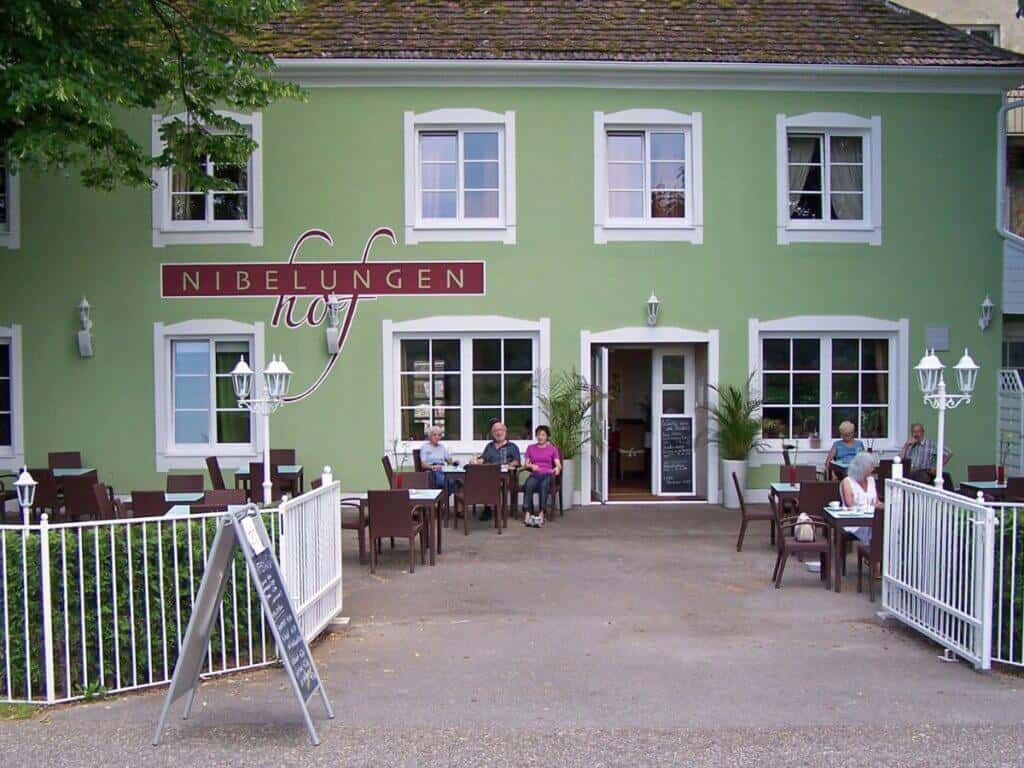
We booked all our accommodations in advance so that we would not have to waste time looking for hotels, and they were all located right on the bike route. Also, we did not have to concern ourselves about late arrival if we stopped to sightsee along the way.
There are situations where others have had to contact 6 or 7 hotels before they found one. On Friday and Saturday evenings, in particular, space can be difficult to find as locals head out for weekend trips.
Accommodation along the Danube
To find hotels, check out booking.com, Expedia, and there is also HostelWorld.
Many of us riding on this route had a room at the same hotels, and we would often see the same people in the restaurant at night. All had bicycle storage facilities. I stayed at the following hotels during our bicycle ride along the Danube:
* Rotel Inn – Passau, Germany – right on the bicycle path
* Faustschlossl, Aschach – across the river from the bike path
* Hotel Zum Goldenen Schiff, Enns – located in the main square
* Gasthof Bohm, Persenbeug – featured great river views
* Hotel Alte Poste, Krems – historic hotel located just inside the city walls
* Nibelungen Hof Hotel, Tulin – right on the bicycle path next to the river
* Hotel Stadthalle, Vienna – close to the train station, bicycle parking
Looking for more information on cycling in the area?
If you’re planning on cycling in Germany or Austria and are looking for more information, consider reading some of my other posts:
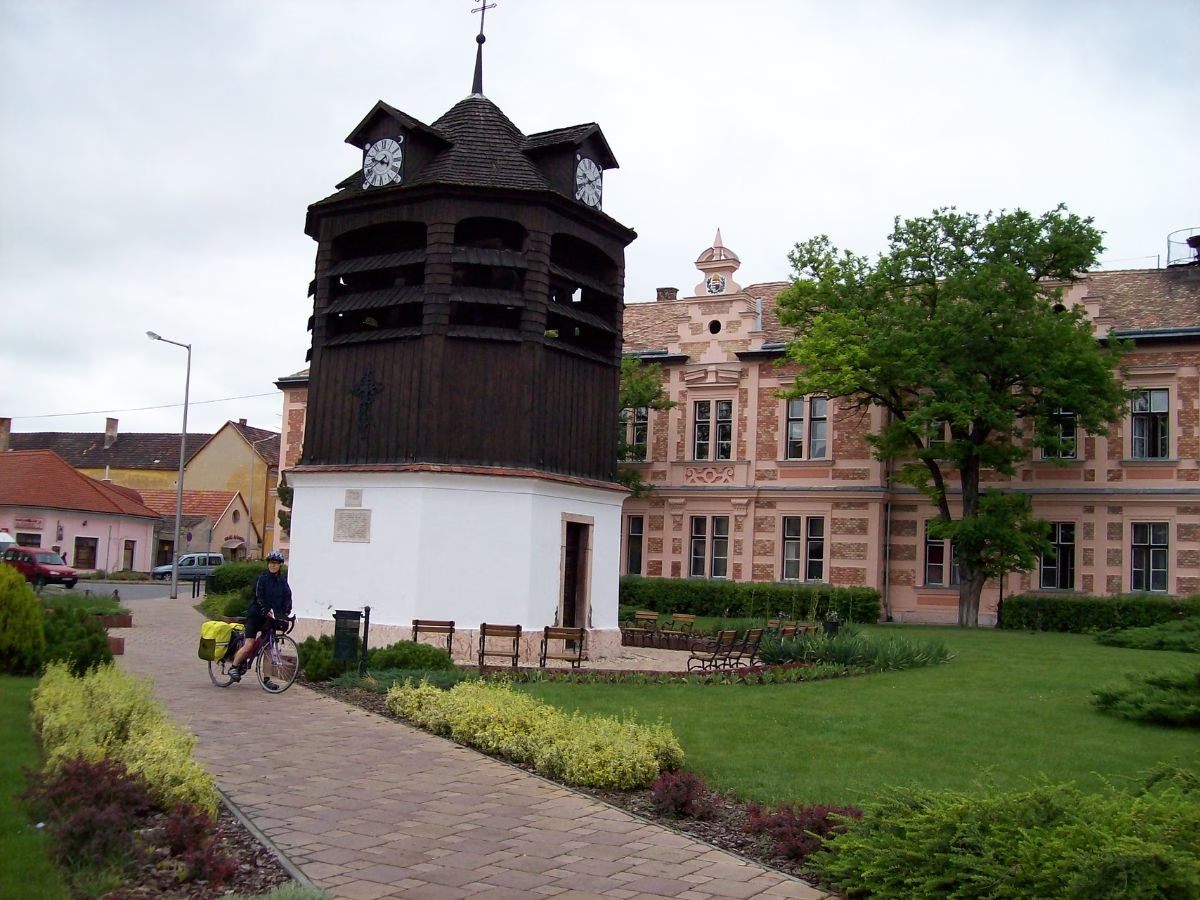
- Continue your journey on the Danube Bike Route from Vienna to Budapest
- Tauern Bicycle Route – from southern Austria connecting to the Danube River via Salzburg
- Salzkammergut Cycling Route – goes through the lakes district near Salzburg
- Adige Cycling Route – from southern Austria to Verona in Italy
- The Bodenese to Königssee – cycling route heads across Bavaria just south of the Danube
- Rhine Cycle Route – the popular route along the Rhine River
- Also consider travel insurance while cycling this route
Many popular routes are also part of the 4,450 km-long EuroVelo 6, which continues this route to the Black Sea. There is also a connecting route heading to Prague in the Czech Republic.
Final Thoughts: Danube Cycling Route
With a guidebook in hand and hotel reservations made, our small group had no problems planning this trip, but there are many guided cycling tours along this route, with all the arrangements made for you. I read the Danube Bike Trail 2 with its detailed maps for the route. Another resource is the Danube Cycleway.
Easy riding with a well-marked route, enchanting river landscape, vineyards, and countless cultural sites with lots of history make the Danube Cycling Path a winner!